

Open Hearted, Clothes Minded
Talking to Christine Morrison, ex-Calvin Klein exec and author of the new memoir-meets-style-manifesto Clothes Minded, about coming of age in 90s NYC and how fashion has always been a feminist issue.

By Cynthia True
Blow-Up: What Gets Remembered
A six-part series expanding the historical record
We’re doing something different this week because over the weekend, I inhaled Christine Morrison’s new book, Clothes Minded, and I just had to talk to her. I had picked up the book, described as a collection of “fashionable essays about finding yourself,” thinking I would read a piece here or there about Miuccia Prada or Marc Jacobs.
But once I started reading, I couldn’t stop. I started writing things down.
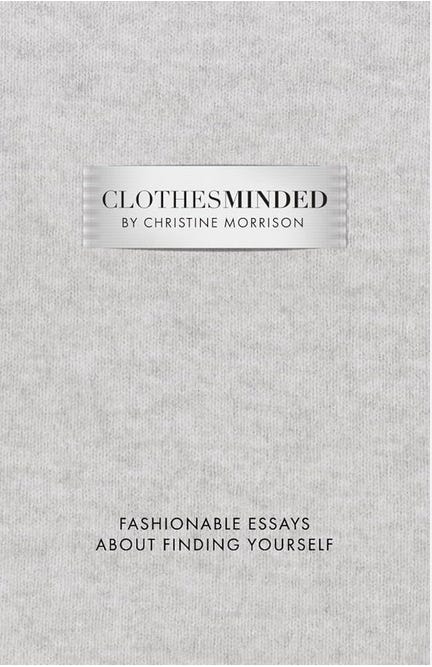
As much a memoir as an essay collection, the book looks back on Morrison’s life so far—dreams pursued, heartbreaks endured, a father lost young, an epilepsy diagnosis—item by beloved item. The throughline, and the thing that made me look at my own wardrobe with new (wide) eyes, is the idea that styling ourselves is an act of self-identification. It’s also a way to soothe ourselves in the worst of times.
That probably shouldn’t be a klieg light moment for me. I just spent two years working on a fashion podcast series. But as I’ve often joked, I never looked worse. The last few years have been a little rough (show of hands, please), and at some point between the pandemic and the Los Angeles fires last January, dressing well—and sometimes dressing, period—seemed unimportant. It was sentences in Clothes Minded, such as “choosing a look is never just about fabric—it’s a decision that telegraphs who we are and who we aspire to become,” that made me look down at my pro-choice t-shirt and black leggings and instantly understand the big problem, whether or not I work from home. Sure, I can pull it together to go out. But chaos reigns in my closet. Why is there a short, tight, hot-pink pencil skirt? Why the decade-old forever-dumb lace top? Why the ruined satin slip dress? Why the other weird dress? The inside of my basic black bag looks better.
What connection does any of this have to the late great 90s Bazaar? There’s a tangential one—Morrison worked closely with Fabien Baron during her tenure as Marketing VP at Calvin Klein—but the real link for me has to do with the way Morrison invites you to think about fashion as something for all of us while having an unapologetic love for serious designers. For all its elevated design and photography, Liz’s Bazaar was surprisingly accessible—an extension of her personal warmth and inclusivity—even as she wore Chanel to the office, something she took great pleasure in once she became the boss.
In that same spirit, Morrison writes about her favorite designers with the unbridled joy of a fan who wants to share, not the jaded industry insider she could easily have become. It’s the only kind of fashion book I can take seriously at the moment. It’s also something I needed to hear.
Cynthia: Christine, your book pulled me in from the very first line. You write, “It’s not frivolous. It’s not exclusive. You shouldn’t be required to pronounce Ann Demeulemeester, tap into your 401(K), or buy coveted Gucci knee-high socks to understand that what we wear matters.” That unlocked for me something I didn’t know I was missing.
Christine: Well, you know how much that means. Writing a book is a labor of love!
Cynthia: The most intense labor of love. What was the inception of the book?
Christine: Most of it was written in the summer of 2024 when I signed with Elevate Press. But I had a few chapters from years earlier. Chapter Two, for example, watching Style with Elsa Klensch on CNN and taking notes in my Chicago apartment on Saturday mornings in the 90s, was first written as a journal entry back in 1998. I had also written an essay about my dad passing away, but for the book, I layered in the part about the OshKosh overalls [part of her weekend casual “uniform” when he took ill] and about having to retire them after his funeral.
Cynthia: The way you tie experiences of grief and mortal fear—such as when you find out you have epilepsy—to pieces of clothing is the last thing I expected in a book of “fashionable essays.” I thought it was going to be light!
Christine: My editor, Monica, was great about pushing me. When I first wrote about finding out I had epilepsy, I just kind of wrote, “Oh, and then I went back to Calvin.” And she was like, “I need you to go deeper.” So I would cry and write it again, and she would say, “Oh, great. Ink and tears. A perfect combination.”
Cynthia: One of the most exciting scenes in the book is in Chapter Four, when you walk into the famous Blake store in Chicago the night before you move to New York City. You face down the scary salesperson and make a bet on your future by buying your first luxury piece, an Ann Demeulemeester sweater wrap dress, which you describe as “six feet of fabric.” Do you still have it?
Christine: Oh yeah. 28 years later, I still wear it! It’s literally a wool sheet with five arm holes. You can just wrap it and wrap it.
Cynthia: Genius. I can’t believe you not only kept the dress in perfect condition but also the diagram that came with it, which you put in the book. That image tells the whole story: the intimidation, the aspiration, and the internal shift when you walked out of there. I don’t think I would have dared!

Christine: I just thought, “I’m moving to New York tomorrow by myself. I can walk into this store and buy something.” When I went back to Chicago a few years ago, I was sorry Blake wasn’t there anymore because I wanted to walk past and say, “I’m so proud of where I am today.” People don’t give themselves credit for the baby steps they take to do things for themselves, things that are so monumental at the time. I moved to New York with my dress, and I immediately started taking writing classes.
Cynthia: How much did it cost you, and how many times have you worn it?
Christine: It was something like $495 or $595. Which was a fortune for me. But, of course, the cost per wear is pennies.
Cynthia: You make a strong case for the emotional value of a big purchase. It’s not just a lovely thing, but a promise to yourself about where you’re going. Where did you get that sense of permission around good clothing?
Christine: Well, my grandmother, Cordelia, who I write about in the book, wore red Estée Lauder lipstick and perfume and would take me to Hutzler’s [the well-heeled Baltimore department store] and let me wear her emerald and diamond ring. She didn’t have much money, but she put herself together beautifully. I loved how she possessed herself and how independent she was.
It was also my mother. She didn’t spend a lot, but she was a master at the sewing machine. She would buy McCall’s patterns, and she was so chic. Watching my mom wear those shift dresses and the scarves in her hair, and even at times a blonde wig, while she fought for her independence—after her divorce, she had to ask my dad to get her a credit card!—I associated fashion with carving out your own identity.
Cynthia: As you say in the book, money is a feminist issue. By extension, so is dressing well. And you were doing that very consciously from the age of seven, even planning outfit changes! Why is it that serious fashion people almost always get the bug early?
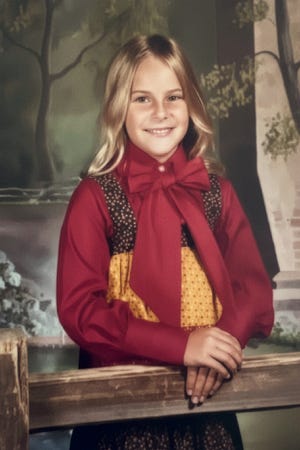
Christine: Something tells me that it’s a little bit innate. I have two sisters, close in age, and we’re totally different. They’re not into clothes.
Cynthia: Was fashion something you shared just with your mom?
Christine: Yes. I mean, one sister says she’s into it, but she’s a terrible dresser. And the other one has never read a fashion magazine!
Cynthia: Speaking of your sisters, you write very honestly about how important it was in your family to be thin. You even write about you and your mom and sisters having weigh-offs to see who’s skinniest—which made me laugh even though I winced a little. Body positivity was not a thing when we were growing up.
Christine: No! It was the Tab generation. Dexatrim. The first anorexic I ever met was someone’s mom at the pool. She was very, very tan and about 85 pounds. I didn’t have an eating disorder, but I was very conscious of my weight. I knew the calorie count for everything. I feel sad for that little girl.
Cynthia: Did you want to be thin for the sake of fashion?
Christine: I think it lent itself to the fashion thing. And then later, going to Calvin, where the look was thin, thin, thin, thin, thin, and sample sizes, I was like, “Oh, I was born to be here.”
Cynthia: I know that becoming VP of Marketing at Calvin Klein was your dream job.
Christine: Yeah, I really fought to get there, and I was like, “I’m going to do the best fucking job ever.” And I think living on lattes was part of that nervous energy. I took that job so seriously. Way too seriously.
Cynthia: There’s been so much hype recently about Calvin Klein in the 90s and CBK and that office culture. What was it like arriving in 2004 right after Calvin had sold the company? Was he still part of the day-to-day?
Christine: Yes, he was still in the building. I think Francisco [Costa] had done two seasons, and it was going great. Everything was very locked in—the look, the way things were done. Nothing had changed. The white walls were constantly being repainted, and nothing went on your black desk except your black pen, the white folders, and the coated black paper clips.
Cynthia: You wrote that the hardest thing about the job was getting dressed in the morning.
Christine: Oh yeah. I was nervous about not looking the part, and I couldn’t really afford many of the Collection pieces. And I wanted to feel good in my clothes because the minute I walked in, I was on. So, like a lot of girls, I figured out that head-to-toe black would work as long as the material didn’t look shiny or cheap.
Cynthia: Same at Bazaar! Go buy more matte black.
Christine: But then you have to get really good shoes.
Cynthia: That is key. Would you say the influence of Carolyn Bessette was still felt in the halls of Calvin?
Christine: It was five years later. You didn’t see photos of her, but I think some of Francisco [Costa]’s looks were variations of her look, especially the silhouettes. You know that famous picture where she’s holding John’s hand as they leave their apartment? She’s wearing the tan skirt and black sweater with the knee-high boots. To me, that was the quintessential Calvin Klein look. Francisco stayed true to those codes.
Cynthia: What do you make of the current fever-pitch fascination with the 90s?
Christine: I think this has probably been said a lot, but I think it’s a hunger for the innocence of who we were and the ability to explore ourselves without AI and social media and Big Brother and all of that. We felt a sense of freedom, and I think people are hungry for that as much as they are for the clothes. Of course, some of the clothes were atrocious. The platform flip-flop!
Cynthia: It was not all cool minimalism.
Christine: The crop tops with the pierced belly buttons.
Cynthia: Criminal. And, of course, it was pre-9/11. I was struck by the connection that you made in your book between the cultural instability triggered by 9/11 and the move to casual clothing—in your case, your Marc Jacobs skinny jeans—because life “felt too precarious to prioritize high style.”
Christine: Yeah. You could open an envelope of anthrax any day. You wanted familiarity, the worn-in, very low-slung jeans. It wasn’t about starched shirts; it was ribbed tank tops. It was the first moment we felt really unsafe. And I don’t think we’ve ever felt truly stable again.
Cynthia: You have this great phrase in the book: sartorial stability. The idea of that, creating stability through your clothing—if you can manage nothing else—is so comforting. I wrote it on a Post-it! I’ve had a rocky couple of years, and I’ve been thinking, “I’ll deal with the clothes later.” But it was your book that made me realize I have to stop wearing my grief.
Christine: You have to start with what you put on every day.
Cynthia: I also appreciate that you provide a solution: The uniform. I think I’ve always unconsciously thought of that as a fashion editor hack. Maybe a little over the top for a civilian. But I see how it’s about creating identity more than it is a pretense.
Christine: The uniform is one less thing to solve. And I swear, feeling good in my clothes and pulling together a cute look does change my productivity and my creativity.

Cynthia: What’s your current uniform?
Christine: Generally, a white button-down shirt. I have, like, 15 of them. I’ll wear ‘em with Liberty print shorts or a pair of vintage Levi’s.
Cynthia: Your book celebrates Marc Jacobs, and Michael Kors, and, of course, Calvin Klein, but it’s mainly a roll call of important women in 90s fashion: Daryl K, Trina Turk, Jil Sander, Cynthia Rowley, Ann Demeulemeester. Can you name your all-time favorite?
Christine: Cynthia Rowley. She represented such whimsy—like those map-printed pants from her 1995 collection that I talk about wearing in the book. I adored what she represented: the grit and gumption it takes to start a business with $3000 and an idea. And Miuccia Prada. That whole “ugly” aesthetic that she talks about being important to explore, that’s very interesting to me. And the fact that Miu Miu and Prada are so distinct, cool, and different from each other is amazing. If I could, I would wear her stuff most of the time.
Cynthia: What was the biggest steal of your life?
Christine: It’s in the book. I was working Seventh on Sale. (Anna Wintour’s annual fundraiser for HIV/AIDS) I got, like, $20,000 off a brown crocodile Dior trench. I still wear it. It was a wild day. I’d waited on Trudie Styler, who was buying her nanny all the things. Michael Kors and Ellen Pompeo were there, and I was starstruck because I was a total Grey’s fan and I was obsessed with his Palm Bitch runway show. I loved how much Michael Kors loved his mother. And I mean, when he did Celine, that was it for me. That was Celine.
Cynthia: I’m amazed by how many items of clothing you’ve kept over the years. What is the last thing you bought?
Christine: Last fall, I bought a fitted men’s sweater at the Gap in five colors. And a year and a half ago, I bought this Tibi pencil skirt—I love the founder, Amy Smilovic, and her whole Creative Pragmatist approach. The skirt has big, bold snails on it. My friend is like, “That’s so Southern!” I wore it with a black fitted sweater to a school event for my kids, and I’ll wear it next week for a meeting in New York with a nice denim shirt and black loafers. But I have a very edited closet. You don’t have to keep buying.
Blow-Up: When Liz Tilberis Transformed Bazaar is a six-part documentary podcast exploring this moment in fashion history. Explore the full series→
Christine, it was such a pleasure talking to you! Thank you.
Thank you for such a phenomenal conversation!